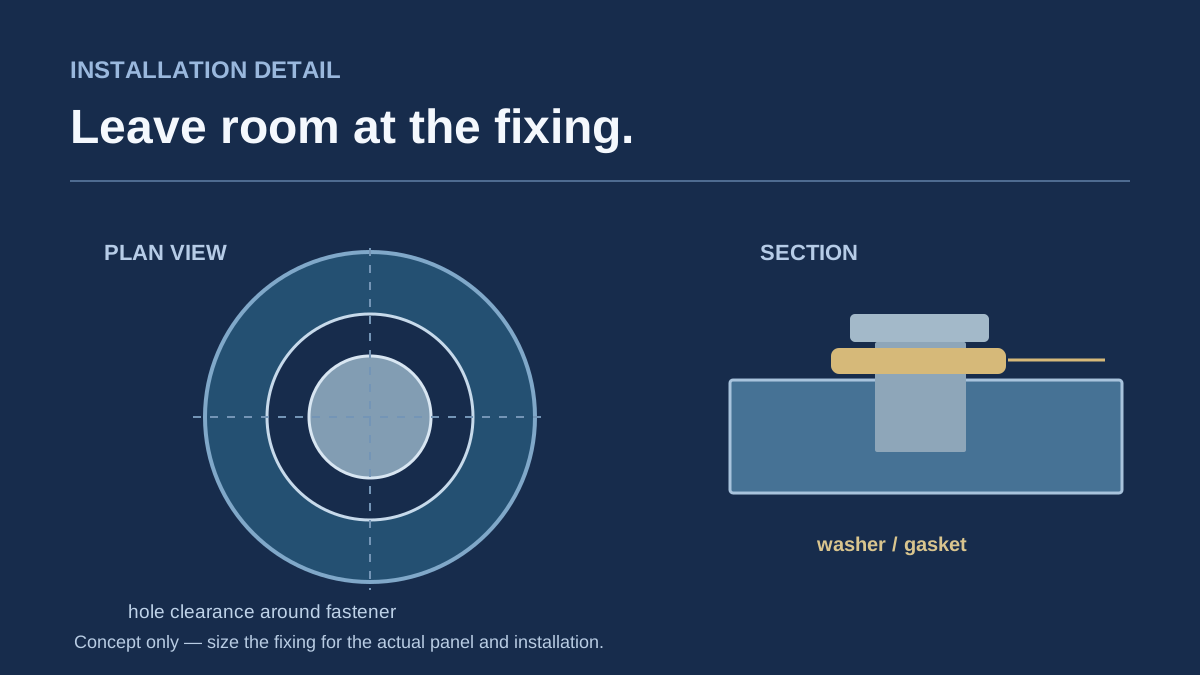
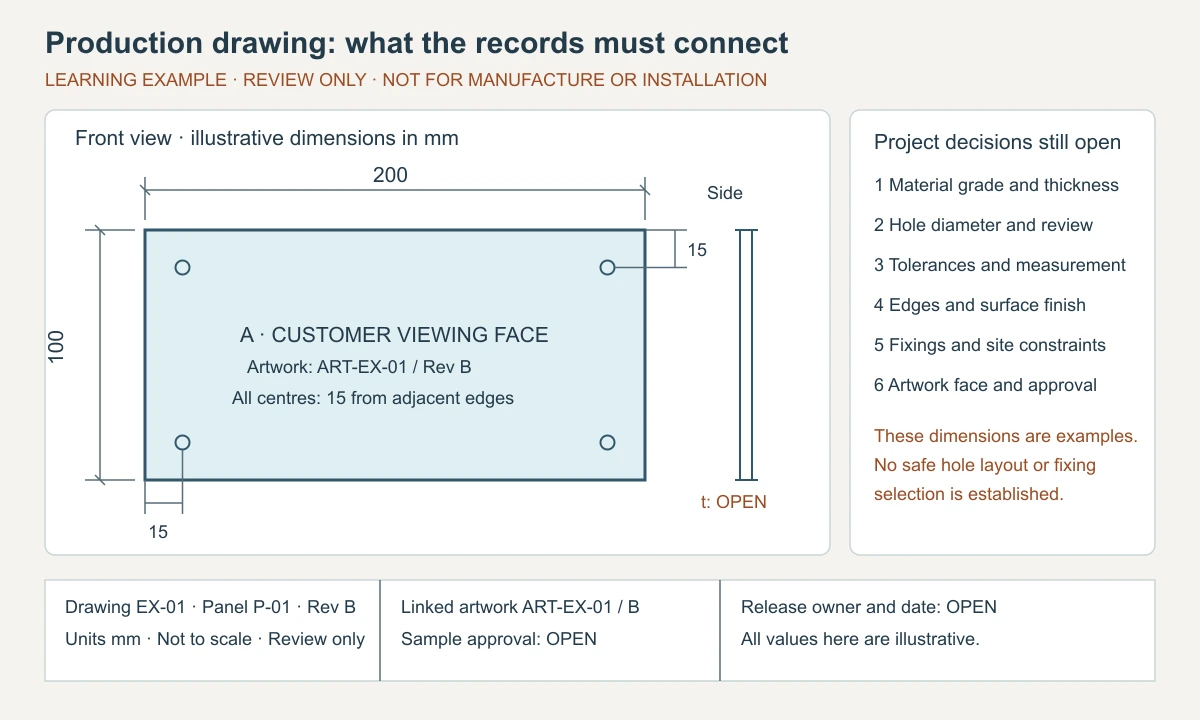
Before ordering an acrylic door sign, record the installation surface, usable area, mounting restrictions and a fixed measurement datum. A front photograph alone cannot locate holes or show what happens when the door moves.
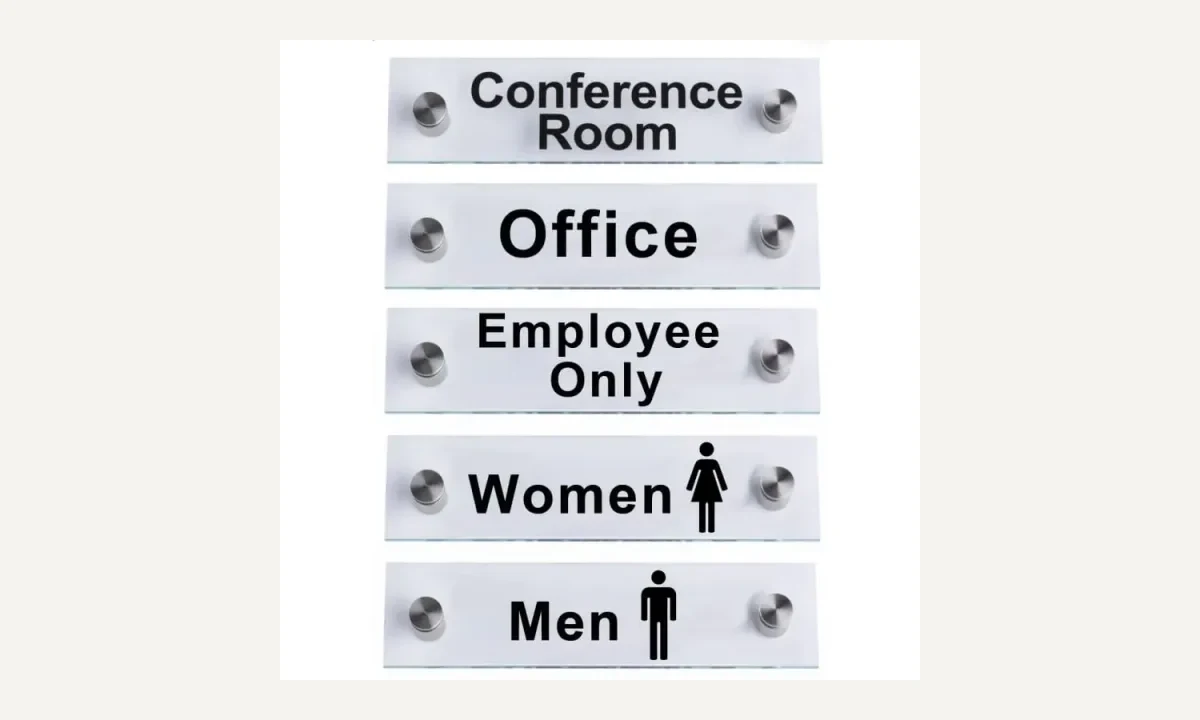
Give each sign location its own survey record
Assign a location ID that also appears on the artwork schedule and packing label. Take a straight-on view with a visible measuring reference and a wider view showing the door, handle, frame and adjacent signs. Note whether the sign mounts on the moving leaf, beside the door or on another surface.
If the project has accessibility, fire-door, landlord or building requirements, obtain the applicable specification from the responsible project team before drawing the sign. A generic product reference cannot settle those location-specific requirements.
Measure from stable datums, not from the edge of a photo
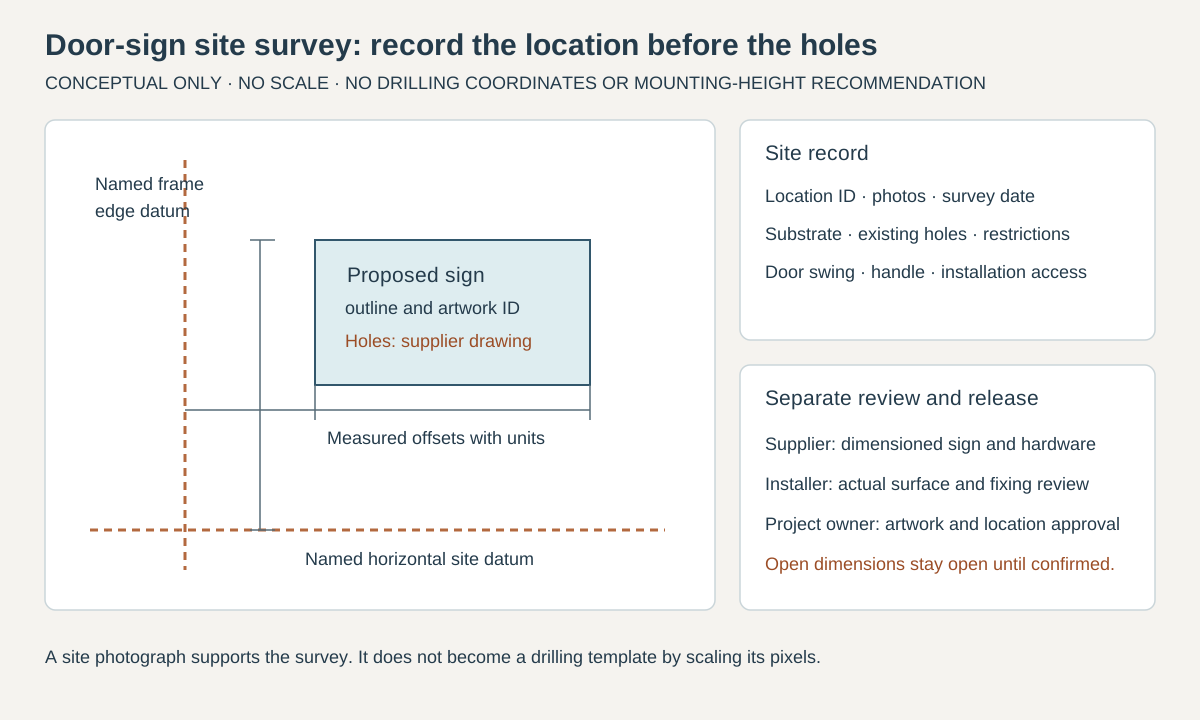
Choose two clearly named references, such as the finished frame edge and a stated horizontal site line. Record their relationship to the proposed sign outline and existing fixing centres. State units, the measurement method and the survey date.
Do not scale a photograph to generate drilling coordinates. Perspective, lens distortion and an unknown sign size can move the apparent hole locations. If replacing an existing sign, distinguish measured hole centres from nominal dimensions copied from an old drawing.
The survey diagram below shows the information path only. It contains no drilling coordinates or mounting-height recommendation.
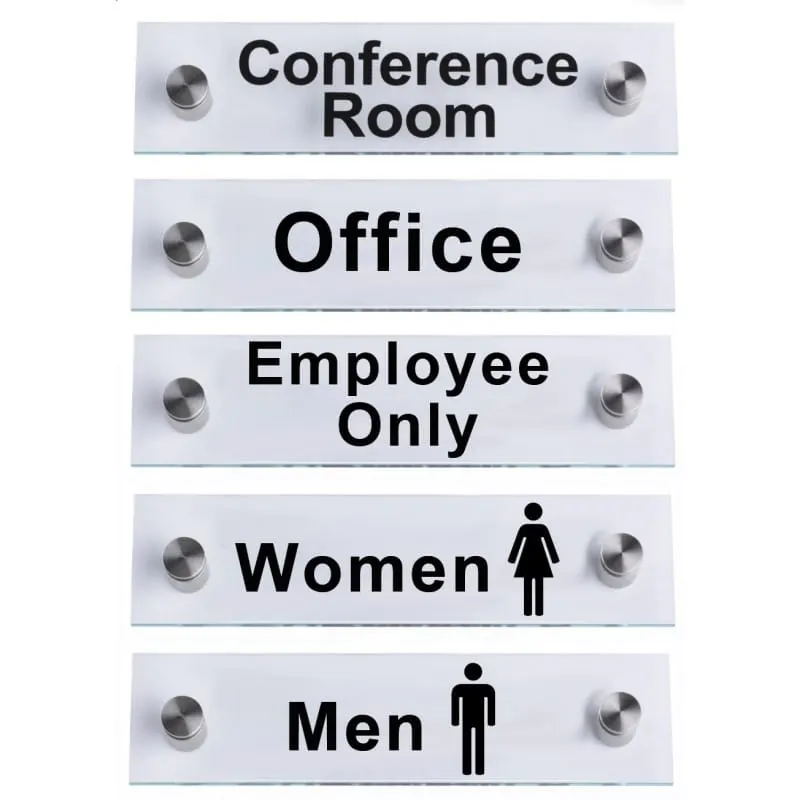
Check movement, substrate and hidden constraints
Trace the door swing and check the handle, latch, frame and nearby wall throughout the intended movement. Add projecting fixings, sign thickness and access needed for installation or insert changes.
Identify the substrate and any restrictions on drilling or adhesives. Ask the installer and supplier to agree a fixing proposal for that actual surface. Record existing holes, concealed-service constraints and who authorizes any new fixing. The acrylic drilling guide concerns fabrication of the panel; it does not approve a wall anchor.
| Record | What it establishes | What remains separate |
|---|---|---|
| Location photos | Orientation, nearby obstacles and intended reading side | Dimensioned production drawing |
| Measured datums | Where the proposed sign sits relative to fixed references | Approved hole layout |
| Substrate and restrictions | Inputs for a fixing review | Installer-approved fixing method |
| Door movement record | Potential interference through the swing | Final on-site verification |
Release the site survey and drawing as separate records
Send the site record with the proposed sign outline, artwork ID and mounting concept. Ask the supplier to return a dimensioned drawing that identifies the panel, holes and supplied hardware. Have the project installer check the drawing against the surveyed location.
A useful hold point is an unresolved dimension or fixing constraint: mark it open and name the person who must resolve it. Release production only against the agreed drawing revision. Confirm the installation sequence and any site verification before drilling.
Download the project record
Use this blank record for the enquiry and agreed sample review. Mark unverified entries “To confirm” and retain the approved revision.
Acrylic Door Signs: What to Measure Before Ordering
Location ID, surveyor and survey date:
Surface, door leaf or adjacent wall, and site restrictions:
Named horizontal and vertical datums with units:
Usable outline, existing holes and measurement uncertainty:
Door swing, handle and installation access:
Artwork ID and intended reading direction:
Supplier drawing revision and installer review:
Open constraints and release responsibility:
Download this blank project record (.txt). Mark unknown entries “To confirm” and retain the approved revision.
Drilling and mounting acrylic panels · What Should a Custom Acrylic Production Drawing Include?.
Specification questions
Can I order from a photo of the old sign?
Use it as an appearance reference. Measure the site and existing fixing centres, then approve a dimensioned replacement drawing.
Does the sign supplier choose the wall anchor from the picture?
The actual substrate and installation constraints need review by the responsible installer and supplier.
Send the reference and project record. TOYUDA is a trading and supply-chain coordination partner and can coordinate specification and sample reviews with suitable suppliers.
Apply this guide to your project brief
Use the recorded interface and review conditions when comparing the proposed reference.
- Sign installation survey references
Confirm the actual construction, dimensions and approval scope for the project.
Prepare your quantity, artwork and delivery details before requesting a quotation.