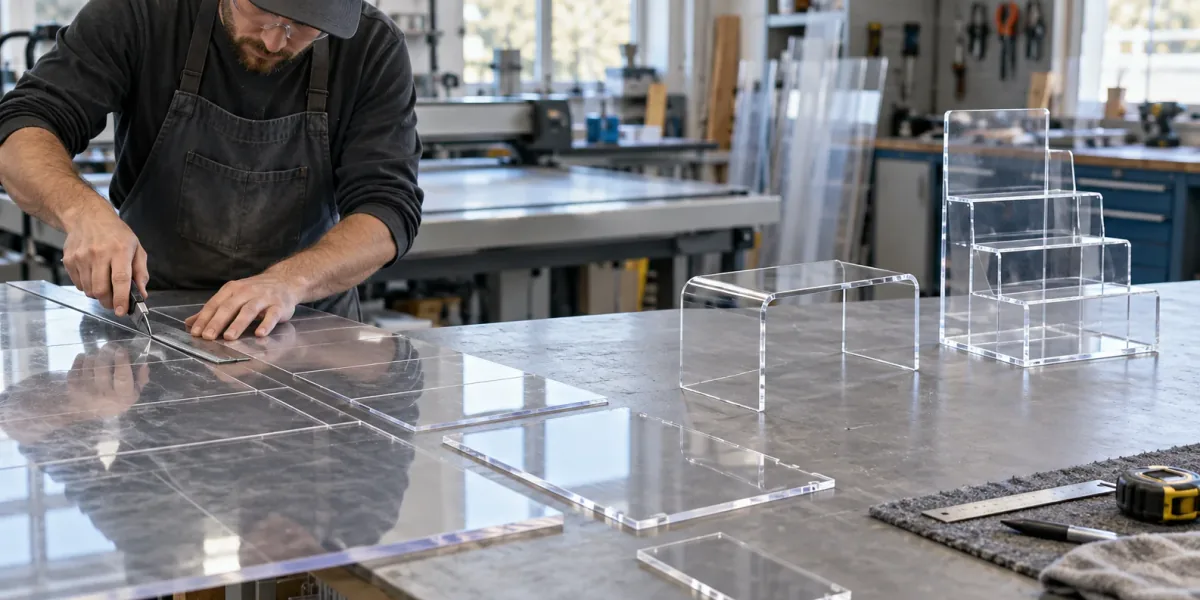
A brochure holder and a curved protective cover may begin as flat sheet. Their paths diverge at the shape.
FORMING / READ THE GEOMETRY
Is it a fold, or is it a surface?
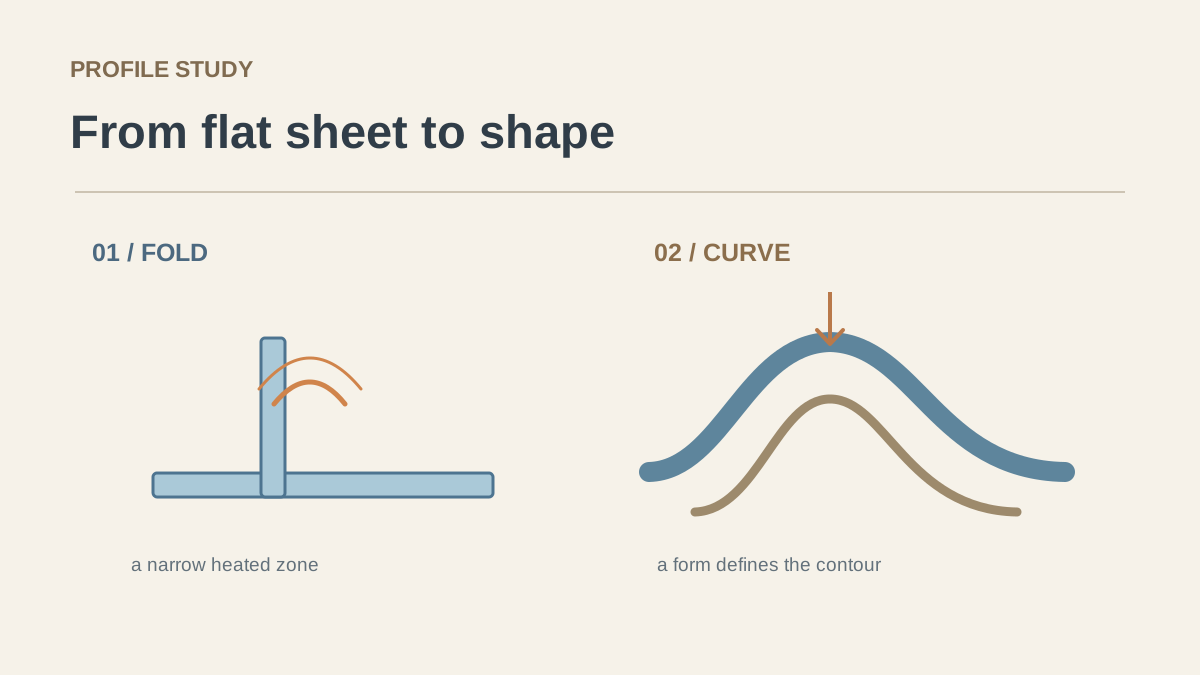
A straight fold concentrates heat along a band. It can suit a sign, riser or simple holder. A dome, tray or smoothly curved cover asks a larger area of sheet to take a shape, often with a form or mold. The second route brings tooling and trial work into the plan.
Review the bend radius, angle and nearby cuts.
Review the contour, trimming and fit after forming.
Heating can change dimensions and introduce stress. Cast and extruded grades may respond differently, so a drawing may need adjustment after the forming trial.
WHAT TO MARK UP
Draw the result, then discuss the method
- 01
Show inside and outside dimensions and the face customers will see.
- 02
Mark the desired radius and any print, hole or adjoining part near the bend.
- 03
Agree which dimensions are checked after forming, when the part has cooled and been trimmed.
If the curve must meet another component, approve a physical formed sample with that component in place.